'The List'
of Understanding
The List
Imagine playing hockey without knowing the rules. You know the goal (get the puck into the net of your opponent) but not the actual rules. You get on the ice, move near the goal and wait for the puck to come your way. When it does, a whistle is blown, gameplay stops and everyone else moves into very specific positions. Gameplay starts again; you gain possession of the puck, and an opposing player barrels into you, knocking you down. People keep playing. You see another player get knocked down and gameplay stops as a different player is taken off the ice and into a booth on the sidelines. Then everyone starts playing again even though the teams are now uneven.
While you might score, it would be very difficult and frustrating to play any game that way. Your success wouldn't necessarily be based on your skills or abilities but your somewhat accidental compliance with the mysterious rules. It wouldn’t be fun or really fair, especially if others did know the rules.
In the workplace, it can be difficult to know the rules. In theory, they may be written out in various HR guides but what are the specific rules of your boss and team? What expectations do they have for successful work? You may know the goal but not the other areas where you are being critiqued. As a team, everyone needs to work together and a set of guidelines provides helpful structure.
After over a decade of development and learnings, I created a list of my “rules.” The ”Conditions of Satisfaction” were documented and shared with my teams. It is a selection of straightforward items that set the mutual stage for cross-team success.
- No surprises
- Remember we are all on the same team
- Take the high road
- Show up
- Attitude is everything
- Lead by example
- Be inclusive
- Take control of your situation / don't be a victim
- Have each other's backs
- Give the benefit of the doubt
Whenever a new employee joined, or an existing team member began to struggle, I would share the list and we would discuss each item. It helped center the conversation and provided a framework for review. If there was an issue with an employee, a reminder of the “rules” generally helped light the path for needed adjustments. Employee success isn’t just about great work but about great working together.
The list was also a mutually agreed upon social contract. As much as I expected my employees to abide by it, I did too. I had a copy of it posted on my wall and, when struggling or feeling off, I would read it again to see which point I needed to pay more attention to. Generally, this was very helpful. Additionally, as new leaders would start, I would share the list with them so they could get a very clear picture of my leadership style and expectations for our new relationship.
The list documented the concepts that I followed for a successful team and working environment. What are your rules and how do you share them?
A shout out to Christopher Hume, my former VP in Marketing, for suggesting the idea of the list almost 20 years ago. Sometimes your legacy can be unexpected and from seemingly small moments.
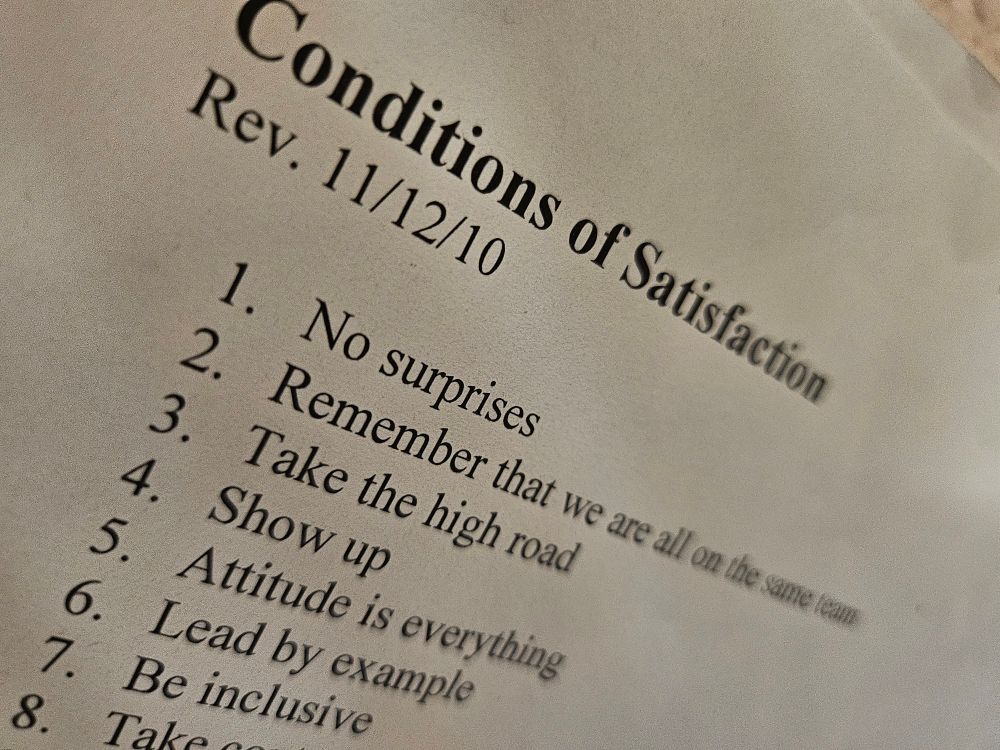
Conditions of Satisfaction
Adjusted over a 15-year period

Did You Know?
"The Conditions of Satisfaction" are effective for in-office, remote, and hybrid work.